

If you have ever wondered what it feels like to have several tons of angry steak sprinting behind you- well, welcome to the San Fermín festival in Pamplona, Spain. Every July, this usually calm and picturesque town transforms into the world’s most adrenaline-filled track meet. Unlike normal athletics, the reward for coming in last is not a medal- it is a horn to the butt. Motivating, right?
This event is more than a simple sprint; it represents a centuries-old tradition, an electrifying cultural phenomenon, and a profound test of nerve. Consequently, understanding the history and atmosphere makes the sheer terror of the run itself far more meaningful.
The following sections break down the experience, from the history to the raw experience of the run, providing a thorough look at the intensity of San Fermín.
What Exactly Is Running With the Bulls?
The event is part of the San Fermín celebrations held every July 6–14. Each morning at 8:00 sharp, energetic- and occasionally overconfident- participants run in front of a group of Spanish fighting bulls along an 875-meter route through the old town to the bullring.
Yes- in front of the bulls. Not next to them. Not behind a fence. In front. Think of it as cardio mixed with ancient tradition mixed with “why am I doing this again?” Originally, the run served a practical purpose: moving the bulls from the grazing fields outside the city walls to the bullring where they would fight in the evening. In the 17th and 18th centuries, young men began jumping in front of the animals to prove their bravery and skill. This spontaneous act evolved into the structured, albeit chaotic, event we recognize today.
Indeed, the run remains fundamentally unchanged, upholding a historical link to Pamplona’s past. Furthermore, the route itself holds significance; it includes the famous stretch known as Estafeta Street, a narrow, winding corridor where the tension and speed reach their peak. Because of this, locals treat the run with a blend of reverence and serious caution, knowing the dangers are very real.
The Atmosphere: A Mix of Fiesta and Fear
The energy in Pamplona during San Fermín is unreal. Streets packed with people in white outfits and red scarves, music everywhere, dancing until sunrise, and the kind of community spirit that makes you feel alive- or at least alive until you realize it is almost 8:00 a.m. and you signed up to run for your life.
Local pros look impossibly calm. Tourists look- less calm. There is always that one guy who thought this would be a great idea after four shots of sangria. It is not a great idea, clearly. However, the pre-run atmosphere also involves the traditional “Chupinazo,” a rocket fired on July 6 that officially marks the start of the festival, unleashing nine days of non-stop celebration. This opening ceremony creates a tidal wave of excitement, fueling the participants and spectators alike.
The night before the run, the town barely sleeps. People socialize in the squares, share traditional churros, and exchange tips- or anxieties- about the morning. Consequently, when the first rocket fires at 8:00 a.m., signaling the bulls have left the corral, a silence descends over the crowd, a momentary, terrifying stillness before the storm. The anticipation, therefore, becomes almost as overwhelming as the run itself.
What It Is Like to Actually Run
Short version: fast. Long version: fast while screaming inside. When the rocket fires, the gates open and the bulls charge. The crowd surges. You run because everyone else is running and because, frankly, you like the idea of living. Running with the bulls forces a profound sense of self-preservation into sharp focus.
Despite the chaos, there is a sense of unity- strangers pull each other up, clear space, and yell warnings like “¡Toro!” which needs no translation. You do not “win.” You just finish. Or jump over a barricade. Both count as victories in my book. The actual sprint lasts less than three minutes for the fastest runners, yet those moments stretch into an eternity of noise, adrenaline, and fleeting glimpses of huge, black bodies charging past. Many seasoned runners describe the experience not as a race, but as a dance with danger, demanding perfect timing and spatial awareness.
Furthermore, one must know when to stop running. Professionals advise runners to find their place, run for a few exhilarating seconds right next to the bulls (the safest place, ironically, as they usually charge straight), and then swiftly pull away by flattening themselves against the nearest wall or barrier. Therefore, success hinges not only on speed but on an acute sense of knowing your limits and respecting the power of the animals.
Tips if You Are Brave Brave Enough to Try It
Participation requires planning, not just a burst of liquid courage. Pick a safer stretch of the route- Dead Man’s Curve is named that for a reason- skip it unless you have a death wish or a YouTube channel. Instead, the final stretch leading into the arena offers fewer blind corners and more escape routes.
Wear proper running shoes- fashion can wait, survival first. Your footwear needs grip and comfort for sprinting on cobblestone streets. Know when to duck out; hero today is better than hospital tomorrow. If you fall, the cardinal rule is simple: stay down, cover your head, and do not move. A bull will likely jump over a motionless obstacle but might charge one trying to stand up. Absolutely no selfies; just… no. Distraction is your enemy, and the penalty for a moment of inattention can be severe. Moreover, authorities take the rules seriously, removing anyone intoxicated or carrying recording equipment to ensure the safety of the group. Hence, your focus should remain entirely on the present moment and the immediate dangers.
Beyond the Run
Even if you skip the sprint of doom, San Fermín is unforgettable. The festival encompasses far more than the daily dash. There are parades, dancing giants (Gigantes y Cabezudos), traditional songs, fireworks, and bullfighting (controversial but historic). You will also find more food and wine than your diet can handle, with local specialties like Pimientos del Piquillo and Navarra wines readily available.
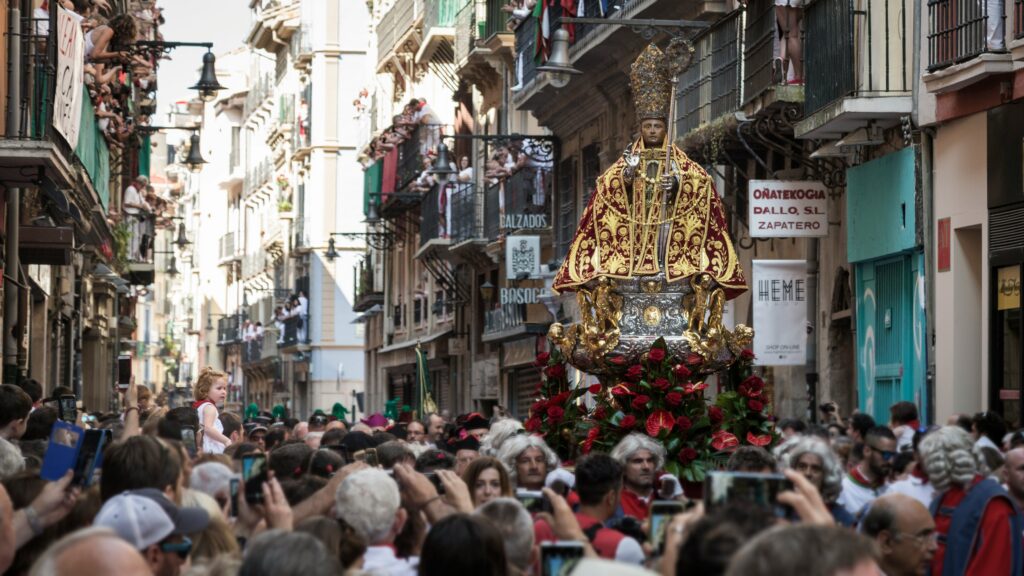
The celebration runs nearly 24 hours a day- you will sleep when you go home. Each evening, the traditional bullfight, or corrida de toros, takes place, drawing massive crowds. Furthermore, religious processions honoring the patron saint, San Fermín, occur throughout the week, reminding attendees of the festival’s spiritual roots. Consequently, the cultural richness of the entire festival transforms Pamplona into a unique space where centuries of tradition meet modern revelry, offering something spectacular for every visitor, even those watching the run from the safety of a balcony. This comprehensive celebration ensures a lasting memory, regardless of your proximity to the bulls.
Final Thoughts
Running with the bulls is not just a stunt- it is a cultural event that has been part of Spain’s identity for centuries. It mixes bravery, tradition, celebration, and a very real reminder to appreciate life- mainly because you feel pretty darn close to losing it. The sheer intensity of the experience creates a primal bond between the participants, an understanding forged in shared risk. Whether you are running, cheering, or spectating from a safe distance with churros in hand (highly recommended), Pamplona during San Fermín is pure electricity. Would I do it again? Ask me when my heart rate returns to normal.